
Beyond the Beer Tents: How to Experience Oktoberfest Like a Local
Most first-timers picture Oktoberfest as a wall of giant steins and roaring tent singalongs. Locals see it as something broader: a folk festival that runs for 16 to 18 days from late September into early October on Munich’s Theresienwiese, packed with fairground rides, parades, brass bands, traditional costume and food that has nothing to do with how much you drink. Families are very much part of the crowd, and long-standing customs give the whole event a texture that gets lost if you spend every hour inside the same tent.
This guide is a compact set of Oktoberfest travel tips to help you plan the timing, find your way around the tents with the right etiquette, eat well and discover the corners of the Wiesn that tourists rarely reach. Follow it and the festival will feel less like a package deal and more like you actually belong there.
Plan Your Visit the Way Munich Locals Do
Timing is the single biggest difference between a local-feeling visit and a tourist one. Weekday afternoons and early evenings are calmer, more convivial and far easier to get around than Friday or Saturday nights, when the biggest tents fill by mid-afternoon and the atmosphere tips from festive into frantic. Weekday lunch at many tents is a genuine perk too: quieter seating, special dishes and servers who actually have time to talk to you. The opening ceremony on the first Saturday is an event in itself, and the closing weekend has a bittersweet energy that regulars love, but both days require the most planning.
On tent reservations: they are essentially mandatory for weekend evenings at the major tents, where tables are often booked months in advance. On weekday afternoons, particularly in the first week, you can usually walk in and find a seat. The smaller side tents are worth seeking out regardless; they tend to attract a more local crowd, play more traditional music and feel considerably less like a theme park.
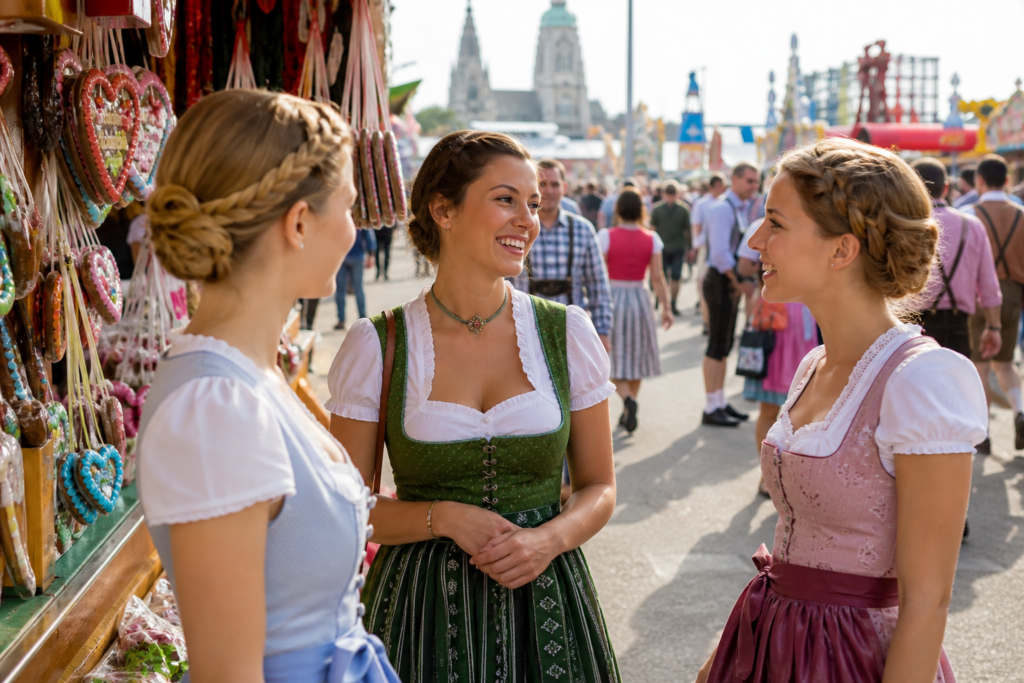
Dress matters, but not in a rigid way. Wearing Tracht, a Dirndl for women or Lederhosen for men, is a genuine mark of respect that locals notice and appreciate. If you do not own traditional clothing, smart casual is perfectly fine; what really matters is closed, sturdy footwear. The tent floors get wet with spills quickly, and a crowd of several thousand people will inevitably step on exposed toes. Avoid sandals entirely.
Bring a mix of cash and card, because many stalls are cash only and queuing at a festival ATM wastes time you could spend elsewhere. Getting to the Theresienwiese is straightforward on the U-Bahn and S-Bahn, with the Theresienwiese and Goetheplatz stops both serving the grounds. Plan your route home before you need it: parks near the grounds are known spots for pickpockets targeting people who are not paying attention, so head for public transport rather than a bench.
Limit yourself to two or three full festival days at most. By day five, even the most enthusiastic visitor is running on fumes, so mixing in a lighter day elsewhere in Munich between tent days makes the whole trip more sustainable.
Oktoberfest Travel Tips for Getting Around the Tents Like a Regular
Each tent has its own personality, and choosing one that matches your mood makes a real difference. Some lean heavily into pop singalongs and a younger, louder crowd; others stick to traditional brass-band music and draw an older, more local clientele. The Augustiner tent has a reputation for being family-friendly and attracting regulars who care about the beer as much as the atmosphere, while the Weinzelt is the place to go if someone in your group would rather drink wine. Locals often have a favourite tent but still wander between a couple across the day, which is a habit worth copying.
The key seating rule: in almost every tent except the Hofbrau, you must be seated at a table or bench before a server will take your order, because standing patrons are simply not served. Table-sharing with strangers is completely normal and often the start of a good conversation. Do not spread bags and jackets across half a bench to hold seats for people who have not yet arrived; it irritates the servers and anyone looking for a spot, and staff will ask you to move them.
Ordering is straightforward once you know the rhythm. Beer comes by the Mass, a full litre, but you can also ask for a Radler, beer mixed with lemonade, if you want to pace yourself across a long afternoon. Ordering food alongside your drinks is both practical and the done thing. When the bill arrives, round up clearly: Bavarian tipping culture is not about percentages but about making your intention obvious, so if the total is 18 euros, saying 20 as you hand over the note is the natural way to do it.
Toasting is a small ritual that locals take seriously. When you raise your Mass, make brief eye contact with the people around you, say Prost and clink steins at the rim rather than the base; clinking low and avoiding eye contact is considered bad luck and will earn you a gentle correction from anyone nearby. As for the songs, you do not need to know the words. Joining in on the chorus, clapping along and standing on the benches when the crowd does are all that is expected. Standing on the tables, rather than the benches, is a different matter: it signals you are about to down your entire stein in one go, a commitment the crowd will absolutely hold you to.
Eat Like a Bavarian: Food Tips That Change Your Day
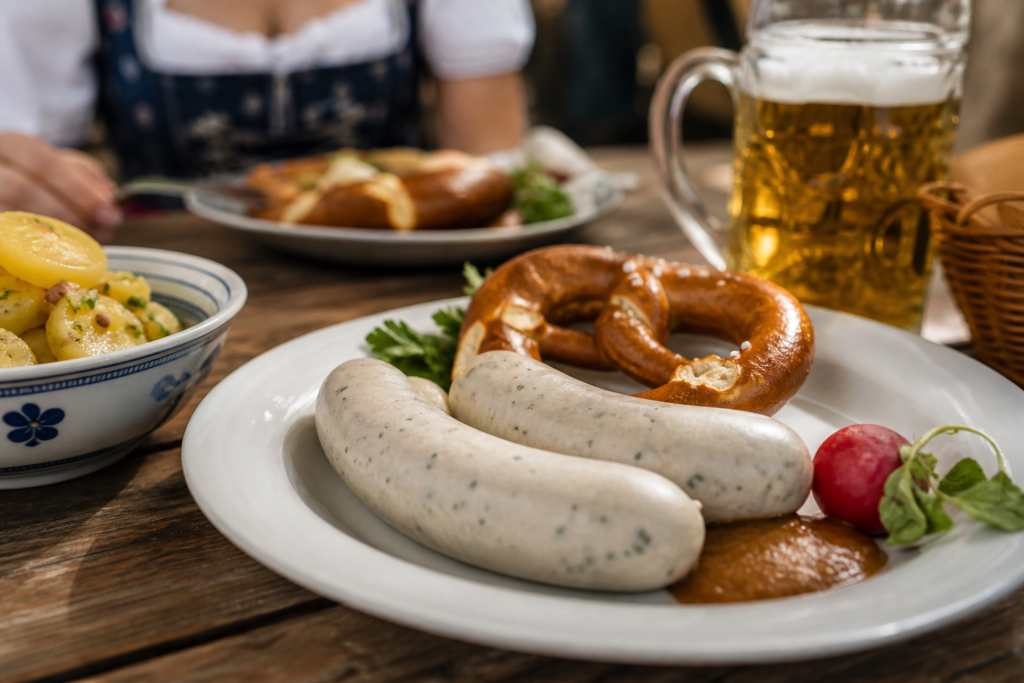
Food is how locals survive a long Oktoberfest day, and the range on offer is far wider than most first-timers expect. The essentials are a half-chicken (Hendl), roasted and juicy, ideally eaten while it is still hot; a soft pretzel the size of your head; Obatzda, a creamy Bavarian cheese spread that belongs on everything; and white sausages (Weisswurst) eaten the traditional way, pulled from the skin rather than bitten whole. Pork knuckle (Schweinshaxe) is the serious eat of the festival, and the grilled fish on a stick (Steckerlfisch) sold from outdoor stalls is one of the best things you will eat all week.
Where you eat matters as much as what you order. Inside the tents, the food is hearty and served in portions designed to absorb a great deal of beer; ordering a whole chicken or a platter for the table rather than individual dishes is the more local approach. Outside, the fairground stalls sell pretzels, roasted almonds, candied fruit and sweet pastries that keep your energy up between sessions. The beer gardens around the outer edges of the grounds are quieter than the main tents and a useful place to sit down properly with food if the tent atmosphere has become a bit much.
Locals use food deliberately to structure the day. A proper sit-down meal before the drinking starts is standard practice, not an afterthought, and a second substantial meal in the late afternoon keeps the evening manageable. Ending with something savoury, a pretzel or a bratwurst from a stall as the night winds down, is as much a tradition as anything else at the festival.
Eat Like a Bavarian: Food Tips That Change Your Day
Beyond Beer: Rides, Oide Wiesn and the Quiet Corners Locals Love
The fairground surrounding the tents is genuinely impressive and completely free to wander. Classic rides include a large Ferris wheel with views across Munich, fast rollercoasters, ghost trains and funfair games. These attractions are not a consolation prize for people who do not want to drink; they are the reason families and locals treat the Wiesn as a full day out rather than a pub crawl.
The best-kept local secret is the Oide Wiesn, a separate enclosed area within the grounds that recreates a more traditional version of the festival. Entry costs a small fee, but what you get inside is noticeably calmer: historic carousel rides, folk-dancing performances, traditional brass bands and a couple of smaller historic beer tents that feel nothing like the main marquees. If you want one hour that genuinely feels like old Bavaria rather than a global party, the Oide Wiesn is it.
Daytime parades are worth planning around. The Grand Entry of the Oktoberfest Landlords and Breweries on the first Saturday is a procession of decorated horse-drawn brewery wagons, brass bands and costumed groups that winds through central Munich before the festival opens. The Costume and Riflemen’s Parade on the following Sunday brings traditional costume groups from across Bavaria and beyond. You do not need a tent reservation or a single drink to enjoy either of them.
For quieter moments, outdoor benches near the tent entrances offer some of the best people-watching at the festival: an extraordinary range of Tracht, visiting delegations in national dress from dozens of countries and the full spectrum of human behaviour at a major public event. Between the fairground, the parades and the Oide Wiesn, there are plenty of fun things to do at Oktoberfest besides drink beer, so a practical way to structure your day is to start outside, take in the fairground or the Oide Wiesn in the late morning, dip into a tent for a meal and a couple of drinks in the early afternoon, then head back out before the noise and crowds peak in the early evening.
Know the Rules, Stay Smart and Get Home Happy
A few customs separate visitors who blend in from those who stand out. Standing on benches during songs is encouraged; standing on tables means you are committing to drain your stein completely, so only do it if you mean it. Stealing steins is taken seriously, with security staff watching for it in every tent and fines steep enough to ruin your evening. Treat the servers well too; they are carrying multiple one-litre steins at once and working brutal shifts, so a polite, straightforward order goes a much longer way than waving or shouting.
On dress: if you are wearing a Dirndl, the position of the bow carries meaning. A bow tied on the left signals that you are single; on the right, that you are taken. It is a small detail that locals notice. More broadly, the atmosphere in the tents is loud, warm and very friendly, but chanting aggressively, blocking narrow aisles for selfies or ignoring staff instructions at closing time are the quickest ways to mark yourself as a nuisance. Closing time is 10:30 in most tents; Kafer stays open until around 1:00, so it fills up fast after the others close.
Keep valuables in a front pocket or a zip-fastened bag, stay with your group when leaving, and use the official toilets and first-aid points on the grounds rather than wandering off. Parks near the Theresienwiese are frequented by pickpockets who target people who are not paying attention, so public transport home is always the better option.
If you would rather hand the planning to someone else, a specialist Oktoberfest tour operator can sort tent reservations, timing and logistics so you arrive knowing exactly where you are going. Thirsty Swagman offers curated Oktoberfest experiences that go well beyond the beer tents, including non-drinking activities and side trips that give the festival real context. Their roundup of fun things to do at and around the Wiesn is a useful starting point for anyone who wants more than just a seat in a tent.